Ending your day: day notes, round two and the hat switch
What happens when the last thing on your Success Day is ticked, why two honest lines in Day notes make tomorrow's plan better, and how the hat switch gives you permission to stop.
Updated 8 Oct 2026
Questions this answers
- What happens when I finish everything on my Success Day?
- A green strip says the day is won, and Thinker asks whether you want a small round two or you are done. Done means the hat switch: go and do the thing you said you would do for yourself. You are not obliged to press round two, ever.
- What is round two in Thinker?
- A small extra set, at most one to three items that genuinely fit the hours left, added only after everything on the day is done. If the hours left are thin, Thinker says the best move is banking the win and adds nothing. It uses a few credits, like any build.
- What are Day notes for?
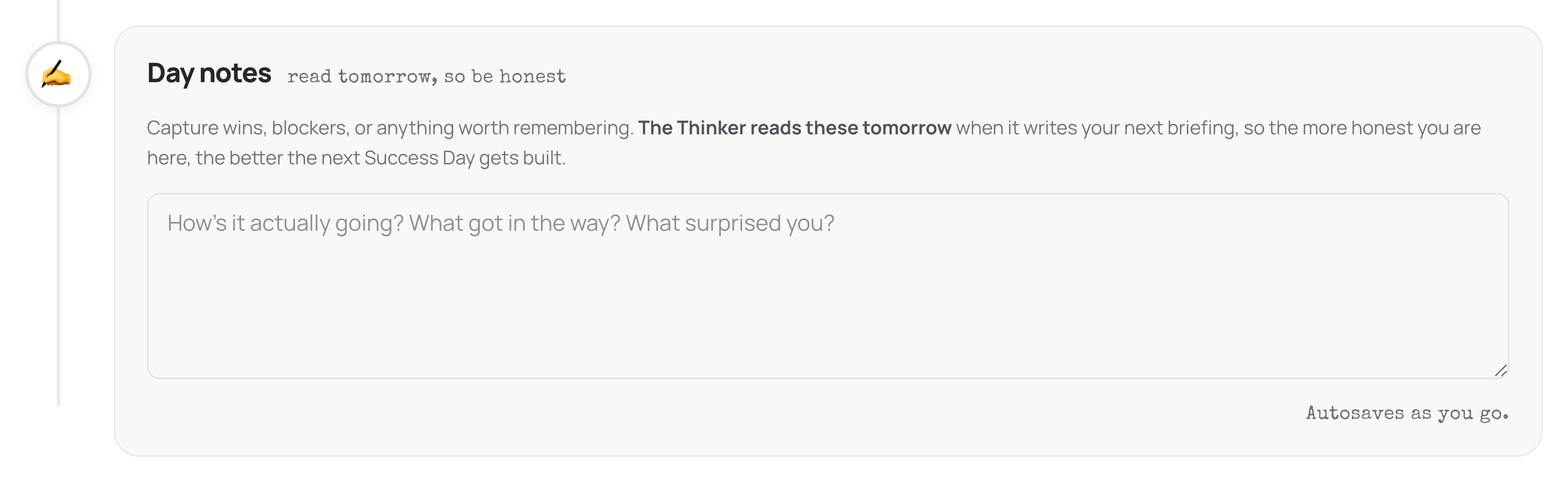
- Two honest lines at the end of the day: what went well, what blocked you, what you are dreading. Thinker reads them when it builds tomorrow and echoes them back in the briefing, so you can see they were read. Concrete to-dos in them become tasks so nothing is lost.
- What is the hat switch?
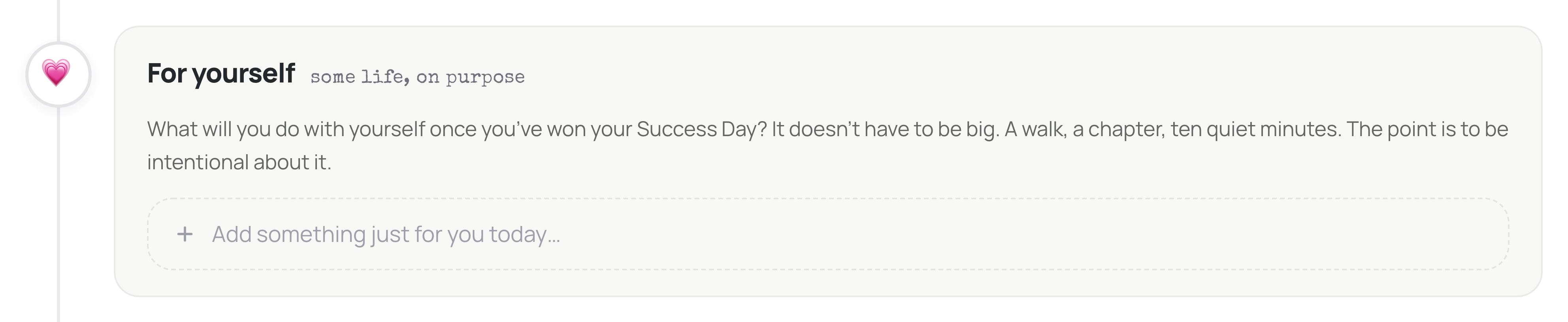
- The one thing that is just for you once the work is done: a walk before dinner, reading on the sofa, seeing someone. It sits in its own callout at the bottom of the Success Day and never blocks the day. When you tick off the last bit of work and choose done, that is what you go and do.
A list has no end, which is why you can work a full day, get loads done, and still finish feeling behind. A Success Day has an end, and this is what happens when you reach it.
When the last thing is ticked
Tick off the last piece of work and a green strip appears: the whole list, ticked. Day won. Then Thinker asks you one question with two answers.
- Round two: a small extra set for the hours actually left. At most one to three items, chosen to move your goal, small and satisfying rather than ambitious. If the hours left are thin, or nothing in the pool is genuinely worth starting now, Thinker adds nothing and tells you banking the win is the right call.
- I'm done for the day: the hat switch. The day closes, and the thing you said you would do for yourself is what you go and do. No guilt, because it was the plan.
The thing for you
Underneath the work, your Success Day has a callout called For yourself: one thing that is just for you. A walk before dinner, reading on the sofa, phoning a friend. Thinker asks for it the first time you win a day, and it never counts toward finishing the day, so it cannot block you.
Most of us went into business to design our own days, then quietly replaced the job we left with a nine to five of busy work. Writing the sofa down makes it the plan rather than the thing you did instead of working, and that is the difference between resting and feeling guilty on a cushion.
Day notes: two honest lines
At the bottom of the Success Day is a box for Day notes. It asks how it is actually going, what got in the way, what surprised you. Two lines is enough. This is the single easiest way to make your days get better over time, because of what happens to them next.
- Thinker reads your recent notes every time it builds a day, and treats them as a message from you to it. A blocker, a carry-over, a tomorrow I need to, all shape what it picks.
- The next briefing echoes your words back in one line, so you can see the note was read. A note honoured invisibly looks the same as a note ignored, so it shows its working.
- Concrete to-dos you mention become tasks, so nothing you wrote at 6pm is lost by 9am. Half-formed maybes go to Ideas. A habit you mention becomes a ritual.
More in Your day
Did that not answer it? Ask Thinker in your own words.
Ask a question